
Available Methods and Accessories
- 8697 Headspace Autosampler
- 7650A Automatic Liquid Sampler
- Syringeless Thermal Desorption
- Solid Phase Microextraction Headspace
Sample Requirements
Syringe Injection
- Liquid (non-aqueous) or possibly gas
- 0.5-5 µL per replicate
- 10 ppm or higher desirable
- Boiling point of entire sample <325℃
Thermal Desorption
- Solid or highly viscous liquid (non-aqueous)
- 0.2-5mg sample
- Boiling point <325℃ (for component of interest)
Headspace
- Solid or liquid
- Amount/concentration can vary
- Boiling point <325℃ (for component of interest)
Summary of Technique
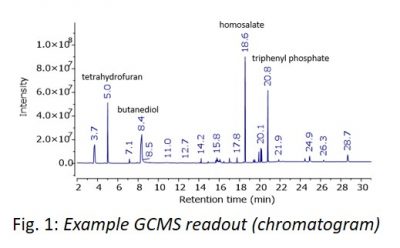
A sample is injected into a heated inlet, then the component molecules of the sample mixture are separated by interaction with a coated capillary column in the gas chromatograph. The separated molecules are detected with a mass spectrometer, allowing for identification.
Information Provided & Detection Limits
GCMS is often the next step after infrared analysis. While infrared can rapidly detect the major functional groups present, GCMS has lower detection limits and can identify minor volatile species present.
Specifications
Electron Ionization
Lab Location and Contact Information
Lab Location: Science 1, G18A
Lab Manager: Capri Price
capri.price@uconn.edu
860-486-5851