
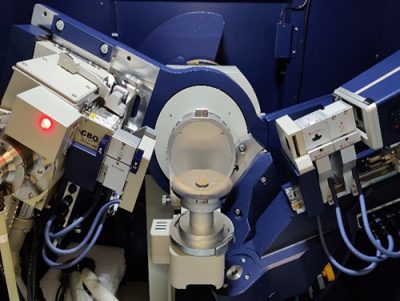
Available Methods & Accesories
The Rigaku SmartLab is a versatile multipurpose X-ray diffractometer with a modular design for powder and thin-film XRD applications. It can be configured for Bragg-Brentano (powder) and parallel-beam (thin-film) geometries. The instrument is equipped with a high-power, 9 kW copper rotating-anode X-ray source and a HyPix-3000 1D/2D detector for rapid data collection.
Available Capabilities
- Powder XRD
- X-ray reflectivity (XRR)
- Grazing-incidence XRD (GIXRD)
- High-resolution XRD (HRXRD)
- In-plane XRD
- Reciprocal space mapping
- Rocking curves
- Pole figures
- Residual stress analysis
- In-situ and temperature-dependent measurements (Anton Paar DSC-350 stage) from −100 °C to 350 °C
Sample Requirements
- Crystalline and semi-crystalline materials
- Amorphous materials can be analyzed to evaluate the presence of detectable crystalline phases
- Powders: approximately 0.05 g–2 g
- Solids: from a few mm³ to 120 mm (diameter) × 25 mm (height)
Summary of Technique
X-ray diffraction (XRD) characterizes crystalline materials by irradiating a sample with an X-ray beam and measuring the intensity of the X-rays diffracted by the crystal structure. As the incident angle changes, crystalline phases produce characteristic diffraction peaks at specific angles. The resulting diffraction pattern provides information about the crystalline phases, crystal structure, and orientation of the sample.
For thin-film and surface-sensitive measurements, specialized geometries such as grazing-incidence XRD and X-ray reflectivity can be used to characterize crystalline structure, film thickness, density, surface/interface roughness, and related structural properties.
Information Provided & Detection Limits
- Identification of crystalline phases and crystal structure
- Semi-quantitative and quantitative phase analysis
- Crystallite size, microstrain, and crystallinity
- Preferred crystallographic orientation and texture
- Thin-film thickness, density, and surface/interface roughness by XRR
- Structural characterization of thin films by GIXRD and HRXRD
- Residual stress and strain analysis
- Phase detection limits depend on the phase, sample matrix, crystallinity, sample preparation, and measurement conditions; minor phases at approximately 1 wt% may be detected under favorable conditions
Lab Location and Contact Information
Location: IPB X-ray laboratory, room 1223
Lab Manager: Daniela Morales
860-486-1824