Web cookies (also called HTTP cookies, browser cookies, or simply cookies) are small pieces of data that websites store on your device (computer, phone, etc.) through your web browser. They are used to remember information about you and your interactions with the site.
Purpose of Cookies:
Session Management:
Keeping you logged in
Remembering items in a shopping cart
Saving language or theme preferences
Personalization:
Tailoring content or ads based on your previous activity
Tracking & Analytics:
Monitoring browsing behavior for analytics or marketing purposes
Types of Cookies:
Session Cookies:
Temporary; deleted when you close your browser
Used for things like keeping you logged in during a single session
Persistent Cookies:
Stored on your device until they expire or are manually deleted
Used for remembering login credentials, settings, etc.
First-Party Cookies:
Set by the website you're visiting directly
Third-Party Cookies:
Set by other domains (usually advertisers) embedded in the website
Commonly used for tracking across multiple sites
Authentication cookies are a special type of web cookie used to identify and verify a user after they log in to a website or web application.
What They Do:
Once you log in to a site, the server creates an authentication cookie and sends it to your browser. This cookie:
Proves to the website that you're logged in
Prevents you from having to log in again on every page you visit
Can persist across sessions if you select "Remember me"
What's Inside an Authentication Cookie?
Typically, it contains:
A unique session ID (not your actual password)
Optional metadata (e.g., expiration time, security flags)
Analytics cookies are cookies used to collect data about how visitors interact with a website. Their primary purpose is to help website owners understand and improve user experience by analyzing things like:
How users navigate the site
Which pages are most/least visited
How long users stay on each page
What device, browser, or location the user is from
What They Track:
Some examples of data analytics cookies may collect:
Page views and time spent on pages
Click paths (how users move from page to page)
Bounce rate (users who leave without interacting)
User demographics (location, language, device)
Referring websites (how users arrived at the site)
Here’s how you can disable cookies in common browsers:
1. Google Chrome
Open Chrome and click the three vertical dots in the top-right corner.
Go to Settings > Privacy and security > Cookies and other site data.
Choose your preferred option:
Block all cookies (not recommended, can break most websites).
Block third-party cookies (can block ads and tracking cookies).
2. Mozilla Firefox
Open Firefox and click the three horizontal lines in the top-right corner.
Go to Settings > Privacy & Security.
Under the Enhanced Tracking Protection section, choose Strict to block most cookies or Custom to manually choose which cookies to block.
3. Safari
Open Safari and click Safari in the top-left corner of the screen.
Go to Preferences > Privacy.
Check Block all cookies to stop all cookies, or select options to block third-party cookies.
4. Microsoft Edge
Open Edge and click the three horizontal dots in the top-right corner.
Go to Settings > Privacy, search, and services > Cookies and site permissions.
Select your cookie settings from there, including blocking all cookies or blocking third-party cookies.
5. On Mobile (iOS/Android)
For Safari on iOS: Go to Settings > Safari > Privacy & Security > Block All Cookies.
For Chrome on Android: Open the app, tap the three dots, go to Settings > Privacy and security > Cookies.
Be Aware:
Disabling cookies can make your online experience more difficult. Some websites may not load properly, or you may be logged out frequently. Also, certain features may not work as expected.
The National Institutes of Health (NIH) has awarded a $2.7 million R18 grant to Kelly Burke, professor and department head of the Chemical & Biomolecular Engineering Department at the University of Connecticut (UConn), to develop implantable drug‑delivery films designed to relieve pain after surgery. The project is funded under the NIH HEAL (Helping to End Addiction Long‑term) Initiative, which backs technologies and strategies that help prevent opioid misuse—in this case by reducing the need to prescribe opioids following common surgical procedures.
The award supports a multidisciplinary team spanning engineering, pharmacy, and medicine. In addition to Burke, the project includes Bin Feng (Biomedical Engineering), Xiuling Lu (Pharmacy), and Courtney Rowe (UConn Health/Connecticut Children’s). Together, the team will design, fabricate, and evaluate thin, biocompatible films that deliver non‑opioid therapeutics directly at the surgical site, targeting the source of pain while minimizing systemic exposure.
Opioids remain a standard option for managing acute post‑operative pain, but they also carry well‑documented risks, including misuse and dependence. By bringing pain relief to the point of need, implantable films could cut the number and strength of opioid prescriptions required after surgery—offering clinicians a practical tool to improve recovery and help protect patients and families from downstream harm.
R18 awards are intended to develop, test, and evaluate health service activities, and to foster the application of existing knowledge to improve health outcomes across defined conditions. Backed by this mechanism, the UConn‑led team will integrate materials science, drug‑delivery expertise, and clinical perspectives to optimize the films’ performance and assess their potential to translate into routine surgical care.
Kelly Burke’s research focuses on biomaterials and drug delivery, with an emphasis on polymer‑based solutions that improve patient care. Burke’s leadership in cross‑disciplinary teams, together with UConn’s strengths in engineering, pharmacy, and clinical medicine, underpins this NIH‑supported effort to create safer, more effective post‑operative pain management options.
Materials Science and Engineering Department (MSE) Head Dr. Bryan Huey congratulated MSE colleague, Dr. George A. Rossetti, Jr., who’s retirement began on August 5, 2025.
Dr. Huey, in announcing Rossetti’s retirement, noted that he is “personally very grateful to George for his friendship, support, intellectual discussions, and advocacy for student opportunities and success.”
George is a renowned expert in electroceramics, with a particular focus on correlations between structure and functional properties and more than 6000 citations throughout his illustrious career. His lab’s specialties include dielectric and piezoelectric measurements, calorimetry, x-ray diffraction, thermodynamic modeling, structural phase transformations, and microstructural evolution. Among other accolades, George’s work was highlighted on the cover of several journals, won the Edward C Henry award for best paper from the American Ceramics Society’s Electronics Division, and earned him a plenary lecture at a US-Japan Piezoelectrics and Dielectrics conference. My own work overlaps with that community, and colleagues regularly talk about that presentation for its deep insights along with his dry humor.
Rossetti earned a Ph.D. in Solid State Science from The Pennsylvania State University, working with Eric Cross. He was a post-doctoral fellow at Princeton University, and then conducted ceramics research in industry for more than a decade. In 2006 Rossetti joined UConn, first in the IMS and soon after as an MSE faculty member.
George has been serving as MSE’s Associate Department Head, and Director of Professional Education, for more than 5 years. He was previously the Director of Graduate Studies as well. Among other courses, for more than a decade George taught two of our most important graduate classes—Structures, and Transport. He has thus helped launch hundreds of students in their careers as materials scientists and engineers, while dutifully serving them and the rest of the department with his topical expertise, careful attention to detail, and industry focus.
“Although he will remain active with UConn as a scholar, he will be missed by the Materials Science & Engineering Department, the Institute of Materials Science, and the College of Engineering,” Huey added.
Board of Trustees Distinguished Professor Dr. Luyi Sun
Dr. Luyi Sun is a globally recognized materials scientist and professor in the Department of Chemical and Biomolecular Engineering at the University of Connecticut, where he also holds a joint appointment in the Institute of Materials Science. Since joining UConn in 2013, he has led an internationally renowned research program focused on nanostructured hybrid materials for functional, environmental, and energy-related applications.
Dr. Sun’s prolific contributions to science are evidenced by over 310 peer-reviewed journal articles in high-impact publications such as Nature Communications, Science Advances, Proceedings of the National Academy of Sciences, and Advanced Materials. His work has earned more than 23,000 citations and an h-index of 83, and has been highlighted by MIT Technology Review, Smithsonian Magazine, and New Scientist, among many others. He is the inventor or co-inventor of 28 issued U.S. patents and more than 50 corresponding foreign patents, seven of which have been commercialized/licensed. The materials and devices invented in his lab have been featured in global exhibitions, including at the Material ConneXion Library in New York and the Penn Museum.
Dr. Sun is a Fellow of the National Academy of Inventors, the Royal Society of Chemistry, and the Society of Plastics Engineers. He has also been recognized with the Morand Lambla Award from the Polymer Processing Society and was elected to the Connecticut Academy of Science and Engineering.
A dedicated educator and mentor, Dr. Sun has taught rigorous and interdisciplinary courses such as Thermodynamics and Polymer Processing, and has advised dozens of Ph.D. students, M.S. students and postdoctoral researchers, and more than 160 undergraduate research assistants. His students have gone on to successful careers in academia and industry, and many have received prestigious fellowships and national honors.
Dr. Sun has also demonstrated sustained leadership in academic and professional service. As Director of the UConn Polymer Program from 2018 to 2021, he expanded faculty engagement and strengthened the program’s profile. He has held leadership roles in national scientific organizations and organized more than 80 symposia around the world. His editorial work includes serving as Associate Editor of Advanced Composites and Hybrid Materials.
Due to his outstanding record of research innovation, teaching, mentorship, and professional service, Dr. Luyi Sun strongly merits recognition as a Board of Trustees Distinguished Professor.
The Institute of Materials Science enthusiastically congratulates Dr. Sun on this honor.
By Paige Bjerke
IMS Written Communications Assistant
Mark Adams, ’93 Polymer Science
Mark Adams received his Ph.D. in Polymer Science from the University of Connecticut in 1993. After an 11-year tenure with Dow Chemical, Adams joined Henry Company in various vice president and senior vice president roles. Following his tenure at Henry Company, Adams joined Associated Materials, acting in senior vice president and later executive vice president positions. Since May of 2023, Adams serves as the Chief Operating Officer of HASA Inc., a large water treatment company based in southern California.
IMS News reached out to Adams with five questions about his breadth of professional experience since obtaining his Ph.D., and how his time at UConn shaped it. Adams shows us that with grit, passion, and a strong support system, career growth occurs naturally.
Why did you choose to pursue your Ph.D. in polymer science at UConn?
My plan was to go to medical school after completing a B.S. in Chemistry from UConn. While working on my B.S., I took Physical Chemistry with Professor Andrew Garton. One day about halfway through the semester, he approached me after class and asked about what I was going to do after undergrad. I told him I was planning to go to medical school. He asked if I had ever considered grad school.
He went on to talk about an opportunity to go to the Institute of Materials Science for a Ph.D. in Polymer Science, working with him under a grant from NASA. Curious about the opportunity, I went to visit him at IMS, and the rest is history. I changed direction and worked to earn my Ph.D. on a research project for NASA, studying the degradation of polymeric spacecraft materials in the low earth orbit.
Who were some of the people who helped or inspired you most during your time at UConn, and how did their influence carry over into your professional career?
Obviously, Professor Garton had a huge impact on my academic career. He was incredibly energetic and excited about his research, which was infectious in his research group. When he passed away suddenly, prior to me completing my thesis, I was shocked and somewhat lost. My mentor in research was gone, and I was uncertain about the future and the choices I made. Fortunately, Sam Huang took me on to complete my degree.
Dr. Garton and other faculty at IMS taught me the importance of first principles and how to do research, but Dr. Garton is responsible for teaching me how to apply learning. How to identify a problem, develop root cause, research/develop technology needed, and implement technology solutions. He also helped me develop continuous improvement skills that have become the backbone of my career. Advanced research is interesting and fun but, using that to develop products and solutions is exciting.
A lot of your professional experience is more on the business side rather than in a lab or research setting. How did your Ph.D. and heavy scientific background impact your trajectory for success in so many executive-level corporate roles?
The first few roles early in my career were focused on technology and product development, which heavily leveraged my Ph.D. Successfully translating these efforts into value-creating opportunities required a complex voice of the customer requirements, which was only obtained and validated through observation and communication with end users. It’s at this interface where my unique skills started to develop, and when my career started taking turns from R&D leadership to new business development, sales, commercial leadership, and operations leadership. I have been fortunate to work with exceptional executive leaders that continually challenged and developed me, which has produced a myriad of different and challenging roles. This would not have been possible without the solid foundation I received from IMS and UConn.
What advice do you have for current polymer science students who may be unsure of their career paths?
Figure out your “internal” job description as early as possible. In other words, determine what you like to do most in combination with the skills and experience you have developed. When you figure out what your internal job description is, and you find a role that matches, you will experience dramatically accelerated growth. In my case, that was away from pure and applied research, and more focused on deploying all kinds of chemistry and engineering to develop solutions that rapidly grow businesses. Once you figure that out, job opportunities come faster than will be comfortable.
What are you most proud of having accomplished so far in your current position, and what do you most hope to accomplish going forward?
I am currently the Chief Operations Officer at a specialty chemical company specializing in water treatment. This role is truly the culmination of all my years of experience in multiple functions and companies. I am responsible for Operations at 12 sites, Engineering, Product/Process Development, EH&S, Continuous Improvement, Quality, and Transportation.
My biggest accomplishment so far with this company has been successfully restructuring and realigning our engineering group into a segmented portfolio management approach. We had way too many projects, worked on all of them at once, with too few resources, and no prioritization. Everything was delayed and above budget. Now, we are executing on time and on budget across the board on a full spectrum of projects from large new site design-builds, down to site specific capex projects.
My biggest challenge is developing and implementing automation technology in our packaging plants. We still require too much manual labor in an environment that is ergonomically challenging. Also, working with hazardous and corrosive materials poses unique challenges to metals and circuitry, so we needed to develop materials, machines, and now robots that reliably operate in challenging environments with hazardous chemicals. I guess it’s kind of like my Ph.D. work that analyzed polymers in low earth orbit, also a challenging and unforgiving environment.
IMS News thanks Mark Adams very much for his willingness to share his unique journey, and we are excited to see where he takes HASA next.
by Paige Bjerke IMS Written Communications Assistant
Ayana Ghosh, Ph.D. (’20)
Ayana Ghosh received her Ph.D. in Materials Science and Engineering from the University of Connecticut in 2020, where she conducted a variety of research projects in the lab group of her advisor, Professor Serge Nakhmanson. After earning her doctorate degree, she joined the prestigious Oak Ridge National Laboratory (ORNL) of the U.S. Department of Energy as a postdoctoral research associate. In 2023, she moved into a full-time position as a staff scientist. In this role, Ghosh has excelled in her research, having won copious awards, spoken at conferences around the world, and gotten published in multiple peer-reviewed journals.
IMS News reached out to Ghosh with five questions about her current position, her many achievements, and her plans for the future.
***
You have clearly set yourself apart at Oak Ridge, having won various awards in just a few years. What skills do you feel propelled you to such impressive success, and what support systems, either within your research team or elsewhere, have helped you the most, and how?
Success in research is often non-linear. It involves many days when things don’t work out or…challenges I don’t fully understand. However, I’ve learned that the key to progress is being able to formulate a clear and meaningful scientific problem and then break it down into manageable parts. This helps me maintain a steady pace toward achieving the final goal. I believe that embracing new ideas and constantly learning—despite the challenges—are key drivers of growth and innovation. Above all, consistency, determination, and resilience have been essential to my success. Giving my best effort, even in the face of setbacks, has played a key role in driving my progress.
The support of my mentors during my postdoctoral work (September 2020 to February 2023), ongoing encouragement from my group leader at ORNL, along with the valuable feedback, collaboration, and shared knowledge from my colleagues and collaborators at ORNL and across the globe, have been instrumental in navigating challenges and advancing my work. I continue to stay in touch with my graduate school advisors and faculty, whose guidance remains invaluable in shaping my research journey.
I would like to express my deep gratitude to my mother, whose unwavering support has been a constant source of strength throughout my journey. After the sudden passing of my father during the pandemic in 2021, I faced the challenge of navigating both personal loss and the demands of my academic work. Her courage has been an anchor, helping me to persevere through difficult times and stay focused on my goals.
Working for ORNL, part of the U.S. Department of Energy, how do you grapple with the importance and scale of your work, which undoubtedly shapes government policy and affects the wellbeing of America and the world at large?
The motivation behind my work has always been the desire to address real-world problems, with the hope to contribute to technological advancements and innovations that improve people’s lives. Working at a U.S. Department of Energy lab, I recognize that my work certainly carries significant weight, particularly knowing that it can influence government policy and ultimately affect the wellbeing of individuals not just in America, but globally. I try to focus on the positive change I hope to drive rather than feel overwhelmed by the scale of it.
I’m also constantly supported by a network of colleagues, mentors, and collaborators who keep me grounded. One of the coolest things about being part of a national lab is the opportunity to casually interact with brilliant minds from various fields. Imagine this: taking an afternoon walk around the building where you might bump into a computer scientist, mathematician, or physicist, and get to chat about the problems you’re working on, gaining fresh perspectives and ideas. It’s amazing how these conversations can spark new ways of thinking, often leading to creative solutions. I also remind myself that progress is often incremental—every small step adds up to a bigger picture. Balancing the scale of my work comes from staying connected to the people and principles that matter most and keeping my focus on the long-term goals.
In 2021, you stated that you “hope to better understand the nuances of experimental research as combined with the particulars of theoretical and simulated data.” Have you been able to gain that understanding at this point in your career? If so, to what extent and how does that understanding inform your current work? If not, what do you feel are the barriers to achieving that understanding?
This is still an ongoing process. Much of my postdoctoral and current work has been dedicated to understanding the nuances between experimental research and theoretical/simulated data. We have made significant strides, particularly in autonomous microscopy, developing machine learning workflows to enhance our understanding of experimental data and integrate it with theoretical simulations.
However, challenges remain, particularly around the disparities between time and length scales. Real-time experiments often don’t align perfectly with theoretical approximations. These gaps require more adaptive approaches. I believe addressing these grand challenges will be crucial not only for my work, but also for improving the synergy between experimental and computational methods. This synergy is essential for unlocking new insights and driving innovation in the world of materials and beyond.
Your Ph.D. thesis was based heavily on machine learning, which you still employ frequently in your work at ORNL. What should current students in the field of materials science know about machine learning and AI, and how would that knowledge benefit them?
For graduate students in materials science, getting comfortable with the basics of ML and AI is crucial. Start by understanding the algorithms, their implementation, and how to apply them to real-world problems. The key is knowing when and how to use these tools, based on solid domain expertise. It’s not just about using fancy algorithms or architectures, it’s about identifying the problems in materials science that can benefit from them. Beyond just applications, there’s also a big opportunity for students to get involved in method development to push the boundaries of what’s possible.
On a broader note, AI is shaking up every field – it’s changing how we teach and learn, too. With AI-assisted teaching, personalized learning, and a wealth of accessible tools, I think we’re on the brink of a classroom revolution. It’s an exciting time. I imagine embracing these changes will only make us all better researchers and learners. So, for students, one piece of advice, don’t just sit back – dive in and start experimenting (in the lab and on the computer)!
With so much recognition already, and new projects going on constantly, what are your goals or specific things you want to achieve over the next 10 years?
Looking ahead, I am committed to pushing the boundaries of my field by advancing technological solutions that tackle some of the world’s most pressing challenges in energy, AI, and quantum technologies. I am particularly excited about the potential of deepening our understanding of the foundational principles of materials physics and bridging theory with real-world experiments. This integration will be crucial in developing practical, scalable solutions that address the evolving challenges in both society and technology.
With an eye on what’s next, my goal is to take on more leadership roles, collaborating with a diverse range of experts across disciplines to drive innovation and create meaningful change. Equally important is my commitment to mentoring young researchers and contributing to the development of the next generation of scientists. At the same time, I recognize the importance of balancing career advancement with maintaining personal well-being, ensuring both professional growth and personal fulfillment.
***
IMS News thanks Dr. Ghosh for taking the time to answer our questions and providing such potent insight into her work. We wish her all the best as she continues her exciting and innovative career journey.
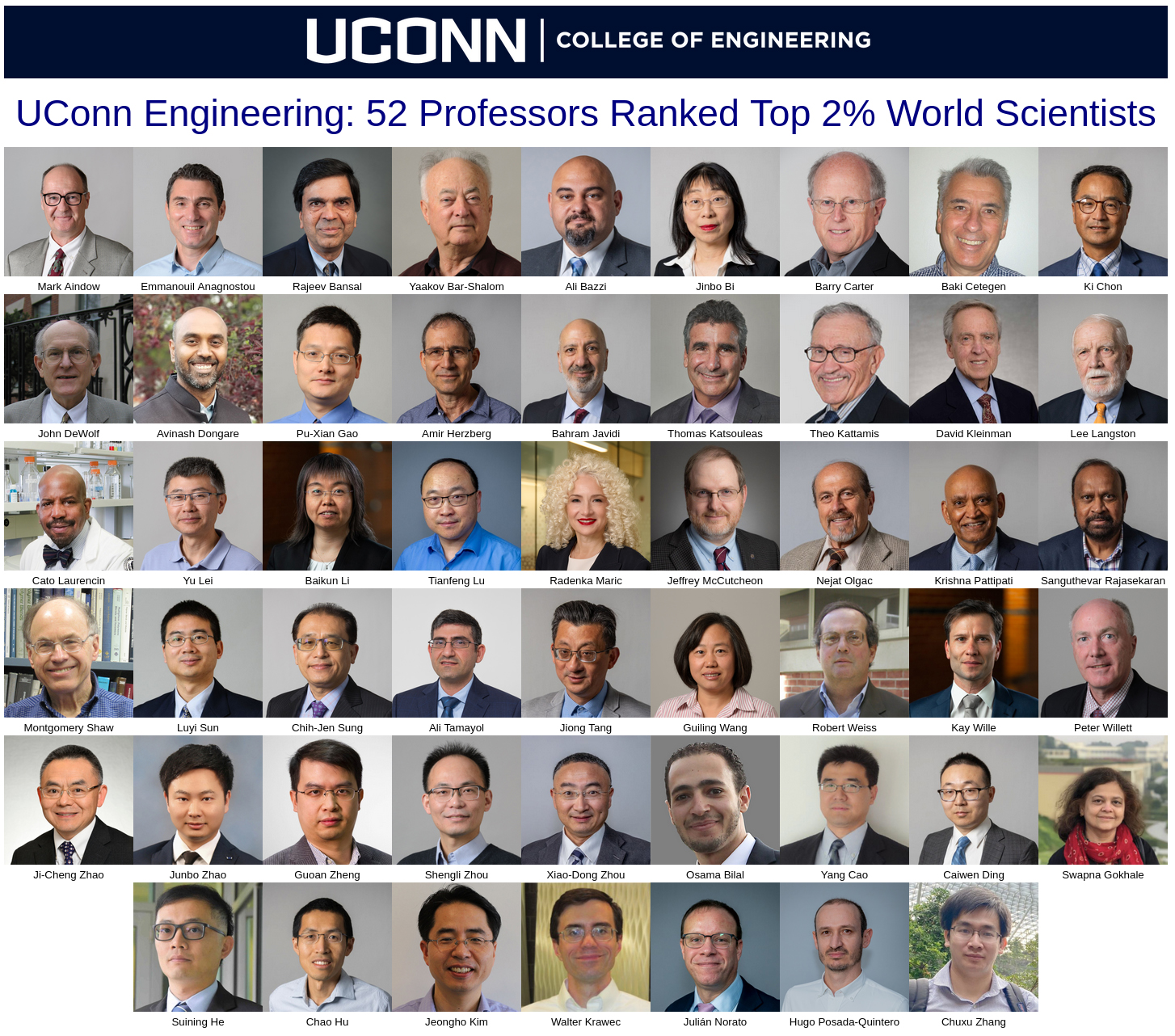
Fifty-two faculty members from the UConn College of Engineering have been recognized among the world’s top 2% of scientists in 2024, according to Stanford/Elsevier’s Top 2% Scientist Rankings. This annual ranking highlights the most widely cited researchers across diverse scientific disciplines, underscoring their significant contributions to research and their global impact. Half of those recognized are Institute of Materials Science (IMS) faculty members.
The top 2% career-long faculty members from UConn’s College of Engineering are: Mark Aindow, Emmanouil Anagnostou, Rajeev Bansal, Yaakov Bar-Shalom, Ali Bazzi, Jinbo Bi, C. Barry Carter, Baki Cetegen, Ki Chon, John DeWolf, Avinash Dongare, Pu-Xian Gao, Amir Herzberg, Bahram Javidi, Thomas Katsouleas, Theo Kattamis, David Kleinman, Lee Langston, Cato Laurencin, Yu Lei, Baikun Li, Tianfeng Lu, Radenka Maric, Jeffrey McCutcheon, Nejat Olgac, Krishna Pattipati, Sanguthevar Rajasekaran, Montgomery Shaw, Luyi Sun, Chih-Jen Sung, Ali Tamayol, Jiong Tang, Guiling Wang, Robert Weiss, Kay Wille, Peter Willett, Ji-Cheng Zhao, Junbo Zhao, Guoan Zheng, Shengli Zhou, and Xiao-Dong Zhou.
This recognition highlights the high caliber of UConn’s engineering faculty, whose research spans critical fields such as biomedical engineering, mechanical engineering, and chemical engineering. Their work not only advances academic knowledge but also offers innovative solutions to pressing global challenges in health care, energy, and materials science.
by Linda Costa IMS Written Communications Assistant
Dr. Avinash Dongare, a resident member of the University of Connecticut’s Institute of Materials Science (IMS) has been elected Fellow of the American Society of Mechanical Engineers (ASME). Dr. Raj Rajendran, Chair of the Executive Materials Division of ASME, surprised Dongare with the nomination.
Dr. Rajendran has known Avinash since 2007 when they met while Dr. Rajendran was serving as Chief Scientist for the Engineering Directorate at the U.S. Army Research Office. During that time, Dongare was serving as Rajendran’s National Research Council (NRC) Fellow, working on modeling the response of complex molecules and single crystals under shock (high pressure and high strain rate) loading conditions.
“It is clear that Dr. Dongare stands among the most outstanding researchers of his generation,” Dr. Rajendran said of his decision to nominate Dongare. “I am confident his innovative research will continue to earn him well-deserved recognition and accolades from his peers.”
Rajendran also noted Dongare’s dedication to the field, noting that he actively serves the scientific community through his roles with ASME and as a reviewer for several leading journals in his area of expertise.
“His service and leadership underscore his commitment to advancing science and supporting the work of his colleagues,” Dr. Rajendran commented.
Dr. Dongare’s current research involves the development and application of advanced computational methods to investigate the behavior and properties of novel materials across multiple scales.
ASME is a nonprofit organization founded in 1880 to help the engineering community develop solutions to numerous challenges.
Ph.D. student, Qiaoling Fan, is a member of Professor J. Nathan Hohman’s group
by Linda Costa IMS Written Communications Assistant
Qiaoling Fan, a member of IMS resident faculty member and Professor of Chemistry, Nathan Hohman’s research group, has been published in JACS (the Journal of the American Chemical Society). Fan is currently a third-year graduate student in inorganic chemistry here at the University of Connecticut.
JACS is a weekly scientific journal published by the American Chemical Society. Published research undergoes a rigorous peer-review process.
Fan’s research, entitled Nucleophilic Displacement Reactions of Silver-Based Metal-Organic Chalcogenolates (MOChas), provides a new synthetic route for the preparation of more elaborate MOChas and heterostructures. Her research has also enabled the preparation of unreachable oligophenyl MOChas which lead to an applicable platform to create complex 2D inorganic phases.
The Hohman Research Group currently includes eight graduate students and one undergraduate student. The group’s research focuses on the design and synthesis of nanomaterials and nanointerfaces for applications, understanding origins of how different structure leads to function in complex materials, and solving synthetic problems. Their work has earned a Department of Energy (DoE) grant to help further their research.
“Working with Dr. Hohman’s group has been fulfilling, both intellectually and creatively,” Fan says. “Collaborating with talented peers in Dr. Hohman’s lab has been a constant learning experience, fostering interdisciplinary thinking and dynamic idea exchanges. What excites me most about our research is its potential real-world impact, particularly in display technology.
Fan earned her Bachelor of Science degree from Sichuan Normal University in Chengdu, China followed by a master’s in chemistry at East China Normal University in Shanghai, China. She also spent time as a high school chemistry teacher in China.
“Teaching at this level was a unique experience that helped me grow both professionally and personally,” fan recalled. “One of the most rewarding aspects of teaching was watching my students grow and develop a curiosity for chemistry. What I hoped my students would take away from my teaching was not just a set of chemical facts but an appreciation for the scientific process and the world around them.”
by Linda Costa IMS Written Communications Assistant
A research study recently published in the Journal of the American Chemical Society (JACS) presents a breakthrough in the design of synthetic copolypeptides which mimic the mechanical properties of spider silk.
The study, entitled Synthesis and In Situ Thermal Induction of β-Sheet Nanocrystals in Spider Silk-Inspired Copolypeptides, was conducted in the research lab of IMS resident faculty member and Professor of Chemistry, Dr. Yao Lin, in collaboration with Dr. Jianjun Cheng, Professor of Materials Science and Engineering at the University of Illinois Urbana Champaign (UIUC). Graduate students Tianjian Yang and Jianan Mao (UConn) and Tianrui Xue (UIUC) provided essential contributions to the study.
Leveraging advanced helix-accelerated, ring-opening polymerization techniques, the research team synthesized multiblock copolypeptides, which undergo a transformation into β-sheet nanocrystals upon heating, achieving robust materials with excellent mechanical integrity, tunability, and processability without the need for solvents.
The study also expands upon traditional poly-alanine-based constructs found in natural spider silk by introducing novel β-sheet-forming amino acids, offering new ways to tailor these materials for specific functional applications. This approach is expected to pave the way for next-generation biopolymer and high-performance fiber materials whose properties will include increases in tensile strength, extensibility, processability, and versatility similar to natural spider silk.
Professor Lin’s group studies bio-inspired macromolecules and materials using the techniques of polymer synthesis, macromolecular characterization, physical chemistry, molecular biology and biochemistry as tools.
George Bollas, a professor in the College of Engineering and IMS faculty member, has been named a 2024-2025 Fulbright Scholar. George, one of five UConn faculty to receive the honor, will be performing research in Greece to investigate the end-to-end feasibility of ammonia as a fuel for the difficult-to-decarbonize transportation sectors. A second focus area of George’s research will be on ammonia cracking and power generation in fuel cells.
Fulbright Scholars are faculty, researchers, administrators, and established professionals teaching or conducting research in affiliation with institutes abroad. Fulbright Scholars engage in cutting-edge research and expand their professional networks, often continuing research collaborations started abroad and laying the groundwork for forging future partnerships between institutions.
Upon returning to their home countries, institutions, labs, and classrooms, they share their stories and often become active supporters of international exchange, inviting foreign scholars to campus and encouraging colleagues and students to go abroad.