Author: Samira
Breathing Easier: UConn Students Build a Smarter HEPA Filter

Smoke from distant forest fires blows into our communities for days at a time. Most neighbors have multiple gas-powered lawn care products that pollute at a higher rate than cars. The quality across the nation has struggled as 44% of Americans live in places with failing grades for unhealthy levels of air pollution, according to the “State of the Air” report published by the American Lung Association. Under the guidance of IMS Polymer Faculty member Douglas Adamson, students from his lab have created AeroGraphiX, a company developing high-tech High-Efficiency Particulate Air (HEPA) filters.
AeroGraphiX uses materials with properties unique to the industry. The filter fibers have a graphene coating which makes them conductive and allows them to maintain an electric charge to increase efficiency. It also allows the filters to include real-time monitoring. Standard air filters can retain moisture and therefore act as catalysts for microbes, however, AeroGraphiX materials are being evaluated for anti-microbial and anti-viral properties. AeroGraphiX materials are also scalable, therefore making them practical for large scale industrial production. These unique properties inspired Dr. Adamson to file a Patent with Robert Minh Lu Williams. Meanwhile, Deep Srivastava and Brenden Ferland have created the company, AeroGraphiX, to further develop the materials and build a commercial product.
The AeroGraphiX team has gained attention as well as funding support from the Entrepreneurship Fellowship Prototyping Grant, Amazon AWS Credits, University of Connecticut CCEI – Get Seeded Award, UConn CCEI Summer Accelerator, Regional NSF iCorps, and UConn 3rd Innovative Health Pitch Fest 2026.
The AeroGraphiX Leadership Team:
· Deep Srivastava – Chemistry Ph.D. Candidate – Chief Executive Officer
· Brenden Ferland – Polymer Science Ph.D. Candidate – Chief Technology Officer
· Robert Minh Lu Williams – Chief Scientific Officer and co-inventor
· Polymer Program faculty member, Prof. Douglas Adamson – Co-Founder, Co-Inventor, & Chief Scientific Advisor
By Osker Dahabsu
Materials Science meets 70000 Volts!
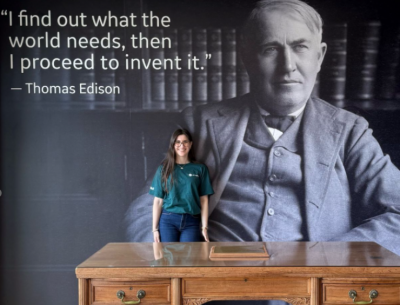
This past summer, Antigoni Konstantinou, a PhD Candidate in the IMS Materials Science Program, spent her summer at GE Vernova’s Advanced Research Center in Niskayuna, NY — a company whose roots trace back to Thomas Edison! Working on generator and transformer insulation materials, Antigoni brought a background in materials science and expertise in high voltage insulation materials to a team tackling real industrial challenges in energy technology.
The summer was packed with unforgettable moments: running first-time high-potential tests up to 70kV, touring a generator manufacturing facility in downtown Schenectady, and sitting down one-on-one with researchers whose published papers Antigoni had studied long before meeting them in person.
What stood out most, though, were the people. Antigoni worked closely with mentors who were genuinely invested in her growth, offering guidance, encouragement, and the kind of support that turns a good internship into a great one. That mentorship didn’t just shape the experience — it shaped the research itself and reinforced her passion for materials science and its role in powering the future of energy.
By Antigoni Konstantinou
IMS Showcases Innovation and Industry Collaboration at 2026 IAP Annual Meeting

Storrs, CT — May 21, 2026 — The University of Connecticut’s Institute of Materials Science (IMS) hosted its annual Industrial Affiliates Program (IAP) Meeting on May 21, bringing together faculty, researchers, students, and industry partners to highlight cutting-edge research, expanding capabilities, and the continued importance of collaboration between academia and industry.
The event opened with remarks from Dr Hatice Bodugoz Senturk, the co-director of the Industrial Affiliates Program for more than a decade. Hatice welcomed attendees and recognized the collective efforts of faculty, staff, technical teams, and students in organizing the meeting. She also acknowledged the retirement of longtime contributor Rhonda Ward who is enjoying retirement after joining IMS in 2013. Hatice introduced Breanna Robbins, her partner in supporting the IAP program, noting her strong technical expertise and collaborative leadership.
Breanna provided an overview of IMS’s growing technical capabilities, emphasizing the institute’s ability to integrate multiple analytical techniques to solve complex industry challenges. She noted that many projects require two or more methods, underscoring the depth and flexibility of IMS resources. Attendees were also introduced to new instrumentation, including advanced microscopes and a nuclear magnetic resonance (NMR) system currently being installed, further strengthening the institute’s research and industry support infrastructure.
Dr. Steven Suib, Director of IMS, highlighted the institute’s continued growth and research impact. He outlined recent investments in advanced equipment and reaffirmed IMS’s commitment to maintaining compliance with federal standards such as EAR, CUI, and ITAR. Suib also emphasized the value of interdisciplinary collaboration across UConn, pointing to opportunities that bring together materials science, polymer research, and biological sciences to drive innovation. The IAP program continues to expand, now comprising 38 members across a range of industries.

Faculty presentations showcased a broad range of expertise and emerging research areas. Dr. Avinash Dangare, Head of Materials Science and Engineering, discussed research on materials under extreme conditions, including the use of high-energy laser systems to study material behavior. Dr. Miu-Ping Nieh highlighted the continued growth of UConn’s Polymer Program and introduced a new international collaboration with the South China University of Technology (SCUT), set to begin in Fall 2026.
Additional presentations featured advancements in micro-mechanical testing by Dr. Seok-Woo Lee, enabling more precise modeling of material performance, and entrepreneurship-focused research by Dr. Mingyu Qiao, who shared insights from his startup experience, including securing $6 million in federal SBIR funding. Dr. Menka Jain presented her work on energy-related and quantum materials, emphasizing their importance in next-generation technologies.

The keynote address was delivered by Kirti Patel, Chief Manufacturing Officer for the Connecticut Department of Economic and Community Development. Patel highlighted Connecticut’s strong economic growth, driven in part by engineering, research and development, and healthcare sectors. He emphasized the critical role programs like IAP play in connecting academic research with industry needs, supporting workforce development, and driving innovation.
A key theme of Patel’s remarks was the need to reduce “friction” — barriers such as limited awareness, inefficient processes, and unclear value propositions. He encouraged organizations to more clearly communicate their capabilities, proactively engage industry partners, and identify measurable outcomes that demonstrate value. Addressing workforce shortages and retaining talent within the state were also identified as ongoing priorities for the State of Connecticut as it continues to support manufacturing as a major growth area for Connecticut and the region.
The meeting concluded with closing remarks from the co-directors, Hatice and Breanna, who thanked attendees and reinforced the importance of continued engagement and partnership.
The 2026 IAP Annual Meeting highlighted IMS’s role as a hub for innovation, collaboration, and workforce development, underscoring its impact on both academic research and the broader industrial community.
Written by Terry Barber-Tournaud
Edited by Breanna Robbins and Hatice Bodugoz Senturk