Uncategorized

IMS Showcases Innovation and Industry Collaboration at 2026 IAP Annual Meeting

IAP Co-Director, Breanna Robbins opens IAP Annual Meeting (Terry Barber-Tournaud / UConn Photo)

Storrs, CT — May 21, 2026 — The University of Connecticut’s Institute of Materials Science (IMS) hosted its annual Industrial Affiliates Program (IAP) Meeting on May 21, bringing together faculty, researchers, students, and industry partners to highlight cutting-edge research, expanding capabilities, and the continued importance of collaboration between academia and industry. 

The event opened with remarks from Dr Hatice Bodugoz Senturk, the co-director of the Industrial Affiliates Program for more than a decade. Hatice  welcomed attendees and recognized the collective efforts of faculty, staff, technical teams, and students in organizing the meeting. She also acknowledged the retirement of longtime contributor Rhonda Ward who is enjoying retirement after joining IMS in 2013. Hatice introduced Breanna Robbins, her partner in supporting the IAP program, noting her strong technical expertise and collaborative leadership. 

Breanna provided an overview of IMS’s growing technical capabilities, emphasizing the institute’s ability to integrate multiple analytical techniques to solve complex industry challenges. She noted that many projects require two or more methods, underscoring the depth and flexibility of IMS resources. Attendees were also introduced to new instrumentation, including advanced microscopes and a nuclear magnetic resonance (NMR) system currently being installed, further strengthening the institute’s research and industry support infrastructure. 

Dr. Steven Suib, Director of IMS, highlighted the institute’s continued growth and research impact. He outlined recent investments in advanced equipment and reaffirmed IMS’s commitment to maintaining compliance with federal standards such as EAR, CUI, and ITAR. Suib also emphasized the value of interdisciplinary collaboration across UConn, pointing to opportunities that bring together materials science, polymer research, and biological sciences to drive innovation. The IAP program continues to expand, now comprising 38 members across a range of industries. 

Attendees of IAP Annual Meeting (Terry Barber-Tournaud / UConn Photo)

Faculty presentations showcased a broad range of expertise and emerging research areas. Dr. Avinash Dangare, Head of Materials Science and Engineering, discussed research on materials under extreme conditions, including the use of high-energy laser systems to study material behavior. Dr. Miu-Ping Nieh highlighted the continued growth of UConn’s Polymer Program and introduced a new international collaboration with the South China University of Technology (SCUT), set to begin in Fall 2026. 

Additional presentations featured advancements in micro-mechanical testing by Dr. Seok-Woo Lee, enabling more precise modeling of material performance, and entrepreneurship-focused research by Dr. Mingyu Qiao, who shared insights from his startup experience, including securing $6 million in federal SBIR funding. Dr. Menka Jain presented her work on energy-related and quantum materials, emphasizing their importance in next-generation technologies. 

Kirti Patel, Chief Manufacturing Officer for the Connecticut Department of Economic and Community Development. (Terry Barber-Tournaud / UConn Photo)


The keynote address was delivered by Kirti Patel, Chief Manufacturing Officer for the Connecticut Department of Economic and Community Development. Patel highlighted Connecticut’s strong economic growth, driven in part by engineering, research and development, and healthcare sectors. He emphasized the critical role programs like IAP play in connecting academic research with industry needs, supporting workforce development, and driving innovation. 

A key theme of Patel’s remarks was the need to reduce “friction” — barriers such as limited awareness, inefficient processes, and unclear value propositions. He encouraged organizations to more clearly communicate their capabilities, proactively engage industry partners, and identify measurable outcomes that demonstrate value. Addressing workforce shortages and retaining talent within the state were also identified as ongoing priorities for the State of Connecticut as it continues to support manufacturing as a major growth area for Connecticut and the region. 

The meeting concluded with closing remarks from the co-directors, Hatice and Breanna, who thanked attendees and reinforced the importance of continued engagement and partnership. 

The 2026 IAP Annual Meeting highlighted IMS’s role as a hub for innovation, collaboration, and workforce development, underscoring its impact on both academic research and the broader industrial community. 


Written by Terry Barber-Tournaud 

Edited by Breanna Robbins and Hatice Bodugoz Senturk

A Hemp-based Thermoplastic Offers a Greener Alternative to Plastic Packaging

Professor Gregory Sotzing

In a study publishing April 30 in the Cell Press journal Chem Circularity, a team of scientists and engineers demonstrates a stretchy, hemp-derived thermoplastic that can extend up to 1,600% of its size. The material has a high “glass transition temperature,” a quality that allows plastics to stay dry and durable when they come into contact with boiling hot water. IMS faculty, Professor Gregory Sotzing, has developed a high-temperature thermoplastic polycarbonate from naturally sourced Cannabidiol (CBD) extract from hemp flower that matches Polyethyleneterephthalate (PET) mechanical properties.

As the global pollution crisis caused by manufacturing and disposing of single-use plastics continues to grow, researchers have developed a non-toxic plastic alternative derived from the hemp plant—a non-psychoactive type of cannabis. Read more


Dr. George A. Rossetti, Jr. Retires

from Materials Science & Engineering Department

George A. Rossetti, Jr.
Dr. George A. Rossetti, Jr.

Materials Science and Engineering Department (MSE) Head Dr. Bryan Huey congratulated MSE colleague, Dr. George A. Rossetti, Jr., who’s retirement began on August 5, 2025.

Dr. Huey, in announcing Rossetti’s retirement, noted that he is “personally very grateful to George for his friendship, support, intellectual discussions, and advocacy for student opportunities and success.”

George is a renowned expert in electroceramics, with a particular focus on correlations between structure and functional properties and more than 6000 citations throughout his illustrious career. His lab’s specialties include dielectric and piezoelectric measurements, calorimetry, x-ray diffraction, thermodynamic modeling, structural phase transformations, and microstructural evolution. Among other accolades, George’s work was highlighted on the cover of several journals, won the Edward C Henry award for best paper from the American Ceramics Society’s Electronics Division, and earned him a plenary lecture at a US-Japan Piezoelectrics and Dielectrics conference. My own work overlaps with that community, and colleagues regularly talk about that presentation for its deep insights along with his dry humor.

Rossetti earned a Ph.D. in Solid State Science from The Pennsylvania State University, working with Eric Cross. He was a post-doctoral fellow at Princeton University, and then conducted ceramics research in industry for more than a decade. In 2006 Rossetti joined UConn, first in the IMS and soon after as an MSE faculty member.

George has been serving as MSE’s Associate Department Head, and Director of Professional Education, for more than 5 years. He was previously the Director of Graduate Studies as well. Among other courses, for more than a decade George taught two of our most important graduate classes—Structures, and Transport. He has thus helped launch hundreds of students in their careers as materials scientists and engineers, while dutifully serving them and the rest of the department with his topical expertise, careful attention to detail, and industry focus.

“Although he will remain active with UConn as a scholar, he will be missed by the Materials Science & Engineering Department, the Institute of Materials Science, and the College of Engineering,” Huey added.

52 UConn Engineering Faculty Among World’s Top 2% of Scientists. Half are IMS Faculty Members

from UConn Today

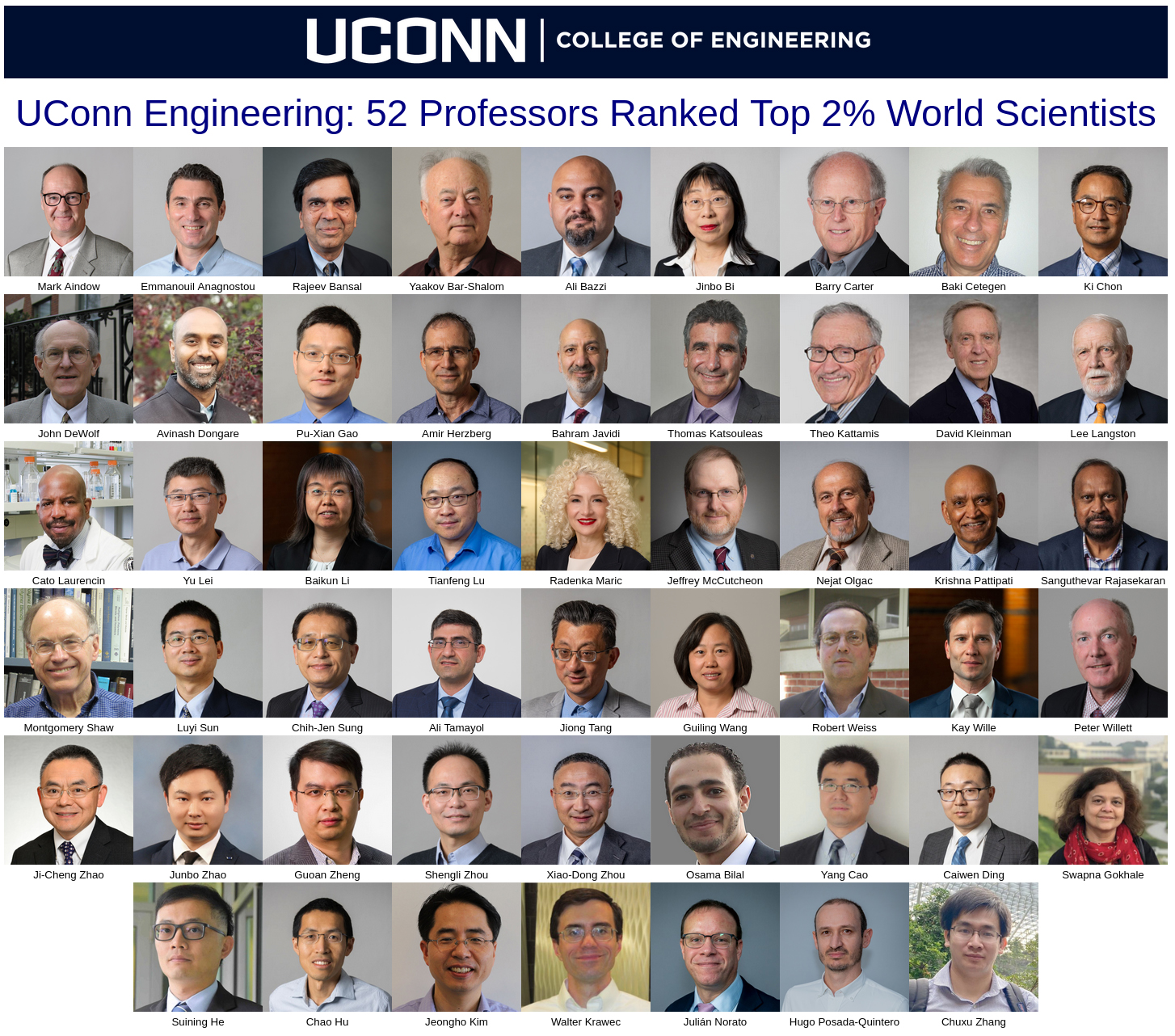
Fifty-two faculty members from the UConn College of Engineering have been recognized among the world’s top 2% of scientists in 2024, according to Stanford/Elsevier’s Top 2% Scientist Rankings. This annual ranking highlights the most widely cited researchers across diverse scientific disciplines, underscoring their significant contributions to research and their global impact. Half of those recognized are Institute of Materials Science (IMS) faculty members.

The top 2% career-long faculty members from UConn’s College of Engineering are: Mark Aindow, Emmanouil Anagnostou, Rajeev Bansal, Yaakov Bar-Shalom, Ali Bazzi, Jinbo Bi, C. Barry Carter, Baki Cetegen, Ki Chon, John DeWolf, Avinash Dongare, Pu-Xian Gao, Amir Herzberg, Bahram Javidi, Thomas Katsouleas, Theo Kattamis, David Kleinman, Lee Langston, Cato Laurencin, Yu Lei, Baikun Li, Tianfeng Lu, Radenka Maric, Jeffrey McCutcheon, Nejat Olgac, Krishna Pattipati, Sanguthevar Rajasekaran, Montgomery Shaw, Luyi Sun, Chih-Jen Sung, Ali Tamayol, Jiong Tang, Guiling Wang, Robert Weiss, Kay Wille, Peter Willett, Ji-Cheng Zhao, Junbo Zhao, Guoan Zheng, Shengli Zhou, and Xiao-Dong Zhou.

This recognition highlights the high caliber of UConn’s engineering faculty, whose research spans critical fields such as biomedical engineering, mechanical engineering, and chemical engineering. Their work not only advances academic knowledge but also offers innovative solutions to pressing global challenges in health care, energy, and materials science.

52 faculty members ranked top 2% world scientists

read the full story at UConn Today.


George Bollas Named 2024-2025 Fulbright Scholar

Dr. George Bollas
Dr. George Bollas

George Bollas, a professor in the College of Engineering and IMS faculty member, has been named a 2024-2025 Fulbright Scholar.  George, one of five UConn faculty to receive the honor, will be performing research in Greece to investigate the end-to-end feasibility of ammonia as a fuel for the difficult-to-decarbonize transportation sectors.  A second focus area of George’s research will be on ammonia cracking and power generation in fuel cells.

Fulbright Scholars are faculty, researchers, administrators, and established professionals teaching or conducting research in affiliation with institutes abroad. Fulbright Scholars engage in cutting-edge research and expand their professional networks, often continuing research collaborations started abroad and laying the groundwork for forging future partnerships between institutions.

Upon returning to their home countries, institutions, labs, and classrooms, they share their stories and often become active supporters of international exchange, inviting foreign scholars to campus and encouraging colleagues and students to go abroad.

UConn Signs Contract With Air Force Research Laboratory

from the Department of Materials Science and Engineering

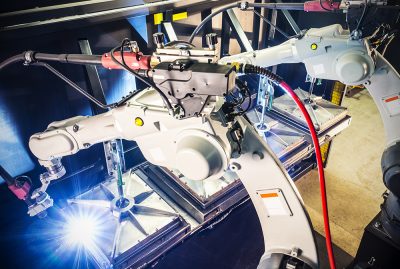
A robotic welding arms in operation.

UConn recently received $10.5 million from the Air Force Research Laboratory (AFRL) for research on high-temperature materials and manufacturing processes. The funding will allow a team of seven faculty members from Materials Science and Engineering (Professors Aindow, Alpay, Frame, and Hebert), Civil and Environmental Engineering (Professor Kim), Mechanical Engineering (Professor Bilal), and Chemistry (Professor Suib) along with post-doctoral associates and graduate assistants to address challenges in the manufacturing of aerial systems intended to fly at high speed. Much of the four-year research project will focus on welding-related challenges for high-temperature metallic materials that are used for structures exposed to high speeds. The UConn team will combine experimental and theoretical approaches to help their collaborator, RTX, advance their manufacturing solutions. Additional project tasks address the behavior of non-metallic high-temperature materials under different processing and service conditions, additive manufacturing of high-temperature refractory metals, and the design and processing of metamaterials. These metamaterials are designed to change heat- and electro-magnetic fields in and around structures and are considered to advance the thermal management of high-temperature structures.

The new AFRL project comes at the heels of previous and ongoing AFRL projects for UConn approaching $30 million that involve over 15 faculty members from the Colleges of Engineering and Liberal Arts and Sciences with dozens of graduate students and post-doctoral associates. Covering research from functional materials and photonics to casting, welding, and additive manufacturing, the UConn team has established itself as a valuable partner for the AFRL and key industry partners, for example, Pratt & Whitney and Collins Aerospace.

Professor Rainer Hebert says of the contract, “The AFRL funding enables the UConn team to pursue materials processing research with a strong focus on industry and government relevance. Students and post-doctoral associates working on the project see firsthand how their research translates to industry. This insight will help in preparing a workforce that can pursue research excellence with a keen sense of the needs and constraints of industrial applications.”

MSE Graduate Student’s Mission: Advance Latino Recruitment, Participation in STEM

Ph.D. Student Luis Ortiz
MSE Ph.D. student, Luis Ortiz

Ph.D. student Luis Ortiz’s passion for materials science was ignited during his undergraduate years at the Universidad de Puerto Rico – Humacao, where he was involved in research focused on physics applied to electronics. He revealed, “In my Applied Physics department in Puerto Rico, we have a program mainly focused on materials research. Based on my experience there, I fell in love with the material science field and decided to pursue my graduate studies in this area.”

Ortiz became exposed to the UConn MSE program through various fellowships he applied to throughout his undergraduate years. He revealed, “We didn’t have much information about UConn in Puerto Rico. As a minority student, I decided to apply for fellowship opportunities that could help me succeed in graduate school at universities in the USA. I also applied to this specific program called the Bridge to the Doctorate Louis Stokes Alliance for Minority Participation while I was an undergraduate student. This is a two-year fellowship that helps you bridge between undergraduate and graduate school, and they supported me through the start of my Ph.D. They have a network of universities inside the program, and UConn was one of the listed colleges.”

During the two-year fellowship, Ortiz was introduced to Professor Bryan Huey, who currently heads the MSE department and serves as his advisor. Luis admits feeling supported by Professor Huey and the other department faculty members. He remarked, “Many people here are willing to mentor students and see us become better professionals. My advisor has been one of them.” Ortiz acknowledged the support he receives from MSE faculty members to pursue his dreams and their confidence in his ability to achieve them. “I feel supported and validated in terms of how we pursue our path and work to achieve our goals,” he said.

Read the full MSE story

EIRC Lab Mates Like Family

Kerry Lynn Davis-AmendolaKerry Lynn Davis-Amendola beautifully shares her experience as a current Ph.D. student in the Electrical Insulation Research Center (EIRC) paying special attention to the importance of her lab mates and the camaraderie that awaited her when she joined the lab.  The inspiring article, The Best Part of a PhD that No One Is Talking About, appears in the “Young Professionals” section of the July/August 2023 edition of the journal IEEE.

Anson Ma Named UTC Professor in Engineering Innovation

Anson Ma
Dr. Anson Ma

Anson Ma from Polymer Program at IMS, with joint appointment in the Department of Chemical and Bimolecular Engineering, has been named the United Technologies Corporation (UTC) Professor in Engineering Innovation, effective 23 August 2022. This professorship has been established to recognize the exceptional achievements of young faculty who exemplify excellence in the areas of research productivity and impact, teaching contributions, and service contributions and are at the very top of their area of research.

Ma’s research group focuses on rheology and 3D printing. He currently serves as the UConn Site Director of the National Science Foundation (NSF) SHAP3D Center for Additive Manufacturing. He has received a number of awards, including Distinguished Young Rheologist Award from TA Instruments, NSF CAREER award, Arthur B. Metzner Early Career award from the Society of Rheology, 3M Non-Tenured Faculty Award, Early Career Award from the American Association of University Professors (AAUP)-UConn Chapter, UConn Polymer Program Director’s Award for Faculty Excellence, and U.S. Air Force Summer Faculty Fellowship.

IMS Welcomes Lisa Conant and Christina Tamburro

As research conducted by UConn IMS faculty members creates more funding opportunities, the need to expand administrative services to support the increased funding has led IMS to hire two new administrative team members.  Both Lisa Conant and Christina Tamburro come to UConn IMS from within the University.

Lisa Conant
Pre-Award Grants and Contracts Specialist Lisa Conant

Lisa Conant previously served as Pre-Award Grants and Contracts Specialist for the Sponsored Program Services (SPS) section of the Office of the Vice President of Research (OVPR). Lisa honed her financial skills in the non-profit social services and municipal sectors. She also provided her financial expertise to The Jackson Laboratory. An avid writer and editor in her personal time, Lisa also loves trying new international recipes. She served her community in Coventry, CT, as an elected town council member for four years and currently serves on the town’s Human Rights Commission. Lisa hopes her years of grants and research administration experience and skills will help support and grow IMS’ already incredibly impressive success in winning research grants and contracts. “My goal is to serve as a resource for IMS faculty and staff in all things pre-award,” Lisa says.

Christina Tamburro
Post-Award Grants and Contracts Specialist Christina Tamburro

Christina Tamburro comes to us from the College of Agriculture, Health and Natural Resources (CAHNR) where she served briefly as Business Operations Specialist before returning to her passion for finance here in IMS. Prior to her time in CAHNR, Christina served as a Post-Award Grants and Contracts Specialist for SPS.  Christina loves cooking and baking.  She won second prize in the Connecticut State Agricultural Fairs statewide apple pie contest in 2005. Additionally, Christina describes herself as a “history nut” with particular interest in the American Civil War and colonial New England. She hopes to contribute additional expertise, enthusiasm and understanding to the grant management process here at IMS.  “I am looking forward to working closely with grant holders, sponsors, and connections throughout the university to extend IMS’ outstanding reputation,” Christina says.

Please join all of us at IMS in welcoming Lisa and Christina.