A miniature ocean-sensing tag developed by University of Connecticut researchers and their collaborators could make it easier to monitor ocean conditions using small fish and other mobile platforms. The work, led by Xueju “Sophie” Wang, an associate professor in the Department of Materials Science and Engineering, was published in Science Advances.
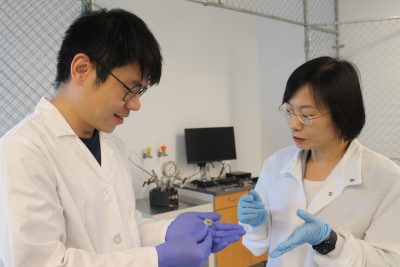
The paper, “A pressure-tolerant, miniature ocean-sensing tag with acoustic telemetry for real-time CTD monitoring,” describes a soft, lightweight system that measures ocean conditions and transmits data underwater using sound. The tag reduces the size and weight of conventional ocean-sensing devices by two orders of magnitude and could offer a lower-cost alternative. UConn MSE PhD student Shao-Hao Lu is the paper’s first author. The PNNL collaborators include Jun Lu, Aljon Salalila, and Zhiqun Daniel Deng, who co-led the study with Wang.
“[Marine biologists] are pretty interested in the technology because of its potential low cost and also its small lightweight feature for integration with ocean animals,” Wang said. “I believe it’ll be … for the benefit of the field.”
Lower costs could make ocean monitoring more accessible. Conventional systems can cost thousands of dollars, Wang said, while her team’s tag could potentially bring that cost down to a few hundred dollars. She is also working with the patent office to explore commercialization.
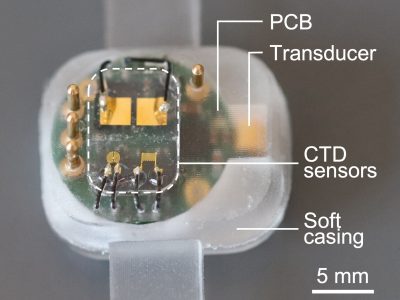
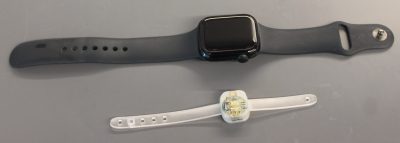
Many conventional ocean sensors rely on heavy metal pressure housings, often made of titanium, to withstand the harsh underwater environment. Those housings add weight and cost and can limit use on smaller marine animals. The new tag uses a soft, flexible casing and weighs just 4.90 grams, including its adjustable watch band. The team demonstrated attachment to a juvenile Chinook salmon, for which the tag represented 1.81% of body weight—below the commonly used 2% guideline for tag burden.
The tag measures conductivity, temperature, and depth, collectively known as CTD. Conductivity helps determine seawater salinity, while pressure indicates depth. Together, these measurements provide essential information for understanding ocean conditions, modeling currents and supporting maritime operations, Wang said.
The system combines millimeter-scale sensors with a battery-powered printed circuit board and an acoustic transducer in a soft elastomer casing. Some earlier flexible sensing systems used Bluetooth, whose signals weaken rapidly underwater and require an animal to surface for data transmission. This tag instead sends data through sound waves, allowing measurements to reach underwater receivers while the tag remains submerged.
The researchers tested the sensors in artificial seawater under repeated bending, changing pressure, and prolonged high-pressure conditions. In the laboratory, the sensors operated at pressures equivalent to a depth of approximately 1,500 meters. In separate field trials in the Salish Sea, tags mounted on a metal pole recorded ocean conditions and transmitted measurements to underwater receivers. Their readings closely matched those from a commercial CTD instrument. Wang credits UConn’s Institute of Materials Science (IMS) with providing a convenient setting for the work.
“Here at IMS, all the facilities are in the same building, which is really convenient for research,” Wang said.
 The research grew out of Wang’s first project as a faculty member at UConn, following a proposal to the Office of Naval Research (ONR). She has received several ONR grants to support the work over the past few years. The project reflects her group’s broader focus on soft materials and flexible electronics for ocean and medical applications.
“After I came to UConn, I basically established my group in the field of soft materials, flexible electronics, for ocean and medical applications,” she said. “This soft ocean sensor can be integrated with many platforms like ocean animals, soft robotics, profilers and health monitoring”.
The potential applications extend beyond fish tagging. By combining soft sensors with underwater acoustic communication, the platform could support ocean monitoring through animal-borne tags, soft robots, and other compact underwater systems.